


Energy Saving and Carbon Reduction

Managing Energy Efficiency with a Manufacturing Mindset

The long operating hours of department stores make energy management a key management priority. To maximize energy efficiency, FEDS applies a manufacturing-oriented approach to managing energy efficiency in the service sector. Since 2015, an energy management team led by the Construction Department has established energy performance indicators (KPIs), regularly reviewed and analyzed energy consumption data, and strengthened equipment maintenance. Through both “smart management” and “hardware maintenance,” FEDS continues to improve energy efficiency and energy management performance.

Establishment of KPIs for Regular Monitoring

In 2025, the Construction Department established nine KPIs covering energy efficiency and equipment maintenance to strengthen energy management. Compared with the previous year, one KPI was retained, three revised, five added, and ten removed. The team regularly tracks and analyzes KPI data each month, helping underperforming branches identify causes and develop improvement plans. High-performing branches are invited to share their practices at management and energy meetings, promoting knowledge exchange and continuous improvement in energy efficiency and management.

Energy Management Indicator

Equipment Inspection Punctuality Rate

Unit:%

Equipment Inspection Pass Rate

Unit:%

Introducing ISO Standards to Improve Management

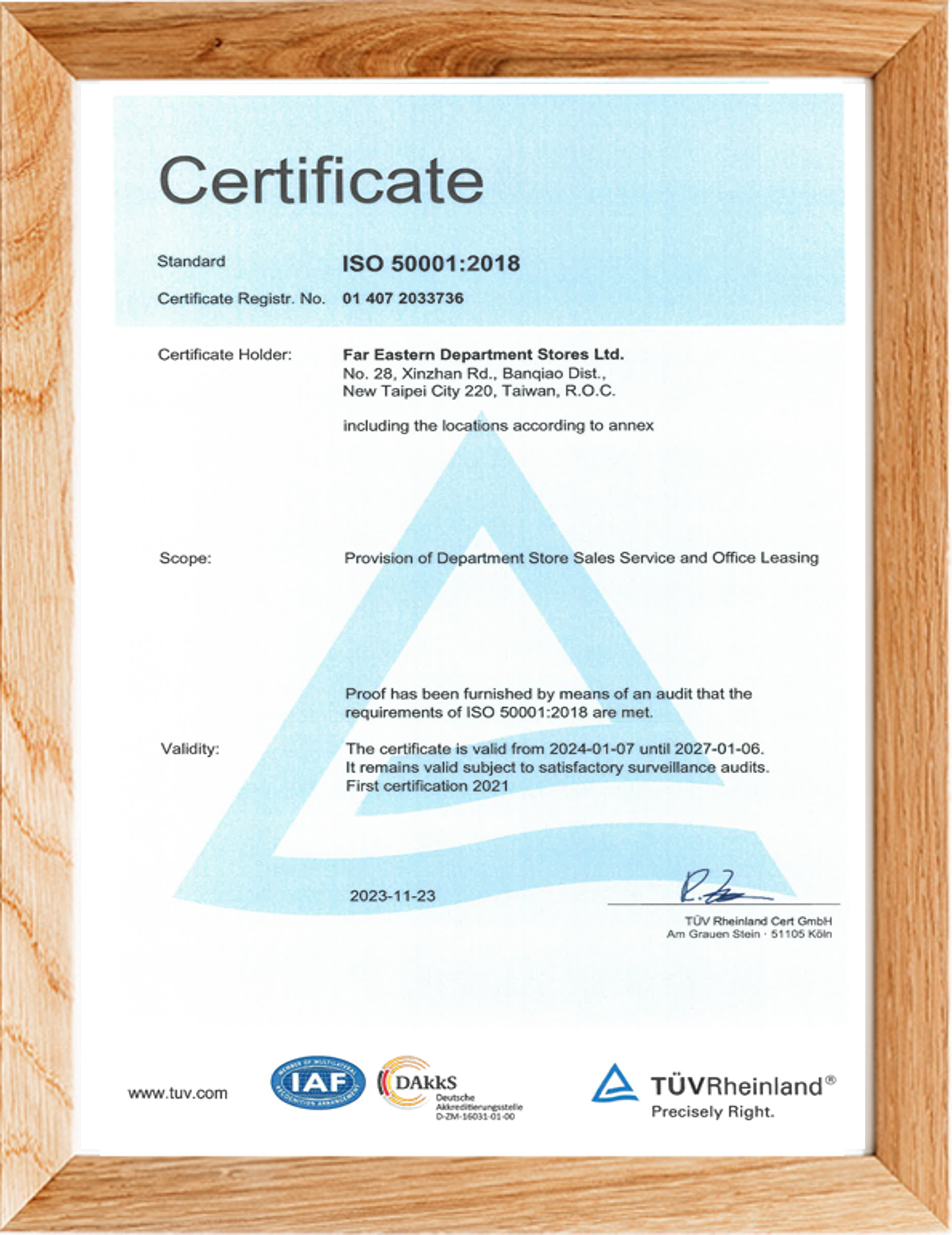
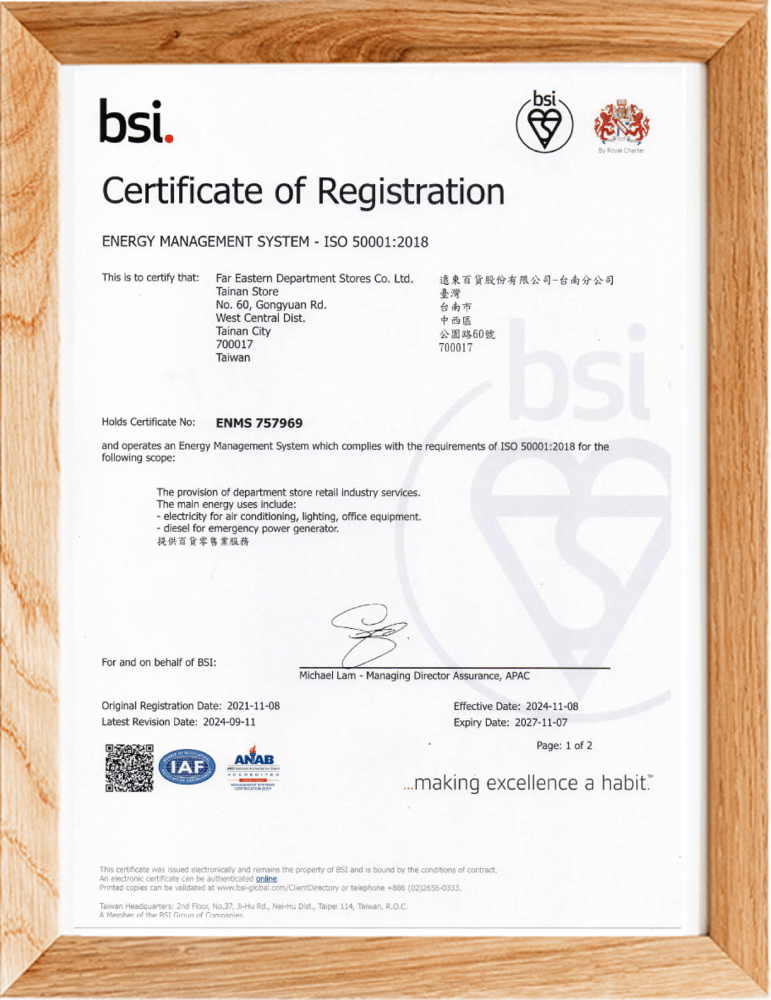
FEDS was an industry pioneer in adopting the ISO 50001 Energy Management System, first introducing it at its headquarters and Mega City Banqiao Store in 2017. In 2018, FEDS launched a real-time energy performance indicator platform at Mega City Banqiao Store, becoming the first department store in Taiwan to implement such a system. In 2021, Tainan Store also adopted ISO 50001. In 2025, FEDS updated its “Energy Management Action Plan Implementation Procedure” and assessed “Energy Risk and Opportunity Registration and Identification Form,” including changes in internal and external issues. Significant risks identified through the assessment were incorporated into energy targets and action plans to strengthen energy management.

ISO 50001 Certification Information

Headquarters, Mega City Banqiao Store

Valid Period: January 7, 2024 to January 6, 2027
Certification Date: November 23, 2023

Tainan Store

Original Registration Date: November 8, 2021
Latest Revision Date: September 11, 2024
Effective Date: November 8, 2024
Expiry Date: November 7, 2027

2017

Implemented ISO 50001 Energy Management System for systematic monitoring to improve energy efficiency.

2018

Established a real-time energy performance indicator platform - the first department store in Taiwan to implement this system, continuously optimizing energy efficiency.

2019

Implemented ISO 14064 greenhouse gas inventory to manage greenhouse gas risks and actively pursue carbon emission reduction.

2020

Executed ISO 14046 water footprint assessment to reduce water consumption and improve water use efficiency.

2021

Tainan Store implemented ISO 50001 Energy Management System to expand energy management efficiency.

2025

Future plans include continuous evaluation for implementation in other stores.

Promoting Energy-Saving Projects

In 2025, FEDS implemented 34 energy-saving projects, investing NT$8.905 million and achieving total energy savings of 4,259,032 kWh. The projects focused on three main areas: AC and ventilation control, lighting improvements, and variable frequency drives. Hardware measures included replacing aging equipment, adopting high-efficiency IE3 motors, and installing variable-frequency energy-saving devices. FEDS also adopted the iAuto Smart Control Platform to optimize energy monitoring and scheduling. Operational measures included AC and chiller scheduling, reduced back-of-house lighting, LED lighting replacement, and off-peak elevator and escalator controls.

Air Conditioning Energy Conservation

  • Reduced operating hours for high energy-consuming air conditioning units in some retail areas.
  • Controlled cooling tower water outlet temperature during non-summer periods.
  • Installed magnetic levitation centrifugal chilled water host units.
  • Added frequency inverters to air conditioning units.
  • Enhanced air conditioning heat dissipation efficiency.
  • Regularly monitored chilled water host unit operating efficiency.
  • Performed regular cleaning of air conditioning system filters and cooling towers.
  • Modified cooling towers to external air wet bulb control.
  • Added timer control for wastewater aeration systems.

Lighting Energy
Conservation

  • Continuously replacing with new energy-efficient lighting fixtures.
  • Using motion sensor lighting in parking areas.
  • Dynamically adjusting lighting brightness based on weather conditions.
  • Light-colored finishes are used for walls and ceilings.

Elevator Energy
Conservation

  • Installing variable frequency control for escalators.
  • Switching passenger elevator operating modes during off-peak hours.
  • Installing automatic on/off devices for elevator interior lighting and ventilation fans.
  • Controlling elevator machine room cooling ventilation fans with temperature control switches.

Number of Energy-Conservation Projects

Unit:cases

Amount Invested

Unit:thousand NT$

Energy Savings

Unit:kWh

Excellent Performance in Energy Efficiency

Energy Use Intensity (EUI), measured by annual electricity consumption per unit area, is one of FEDS’ key energy management indicators. FEDS uses the department store industry’s average EUI as a management target, with the Construction Department monitoring and managing it weekly. FEDS’ EUI decreased from 333 in 2017 to 301 in 2025, a 9.6% reduction. The 2025 EUI also decreased by 2.6% from the previous year, reflecting reduced energy dependence.

In terms of the relationship between sales and electricity consumption, FEDS used 0.0035 kWh of electricity for every NT$1 of sales in 2025, a 20.5% reduction from 2017. This demonstrates the effectiveness of FEDS’ energy-saving initiatives.

Electricity Intensity

Over Nine Years

- 0 %
  • Note: Electricity Intensity = Electricity Consumption (kWh) ÷ Sales (NT$).

Annual Energy Use Intensity Per Unit Area

Unit:kWh/m2.yr

  • Note: The calculation area for Energy Use Intensity (EUI) per unit area annually excludes parking areas.

Electricity Data

Unit:10,000 kWh

  • Note 1: Data for the FEDS Zhubei was added in 2022; data for the Baoqing Store was removed in 2024.
  • Note 2: Due to the pandemic impact, all branches shortened operating hours from May to July 2021, resulting in significantly reduced electricity consumption.

In 2025, FEDS set a 1.5% annual electricity-saving target. Total electricity consumption across its Taiwan operations, including self-generated renewable energy, was 208.75 million kWh, a decrease of 6.11 million kWh, or 2.8%, from 2024, exceeding the target. FEDS continued to implement energy-saving projects to improve efficiency. In 2025, 22 projects focused on optimizing air conditioning and ventilation systems saved 3,658,660 kWh, while six lighting improvement projects saved 168,832 kWh. These projects accounted for 63% of total energy savings. Going forward, the Construction Department will continue to strengthen energy management to further improve energy efficiency.

Towards the target of net zero emissions by 2050 and in line with the government’s energy transition policy, FEDS launched its green energy initiatives early. Two branches – Top City Taichung (opened in 2011) and FEDS Xinyi A13 (opened in 2019) – have installed solar power generation systems with a combined capacity of 96 kW. To expand green energy usage, FEDS launched the ‘Green Power Plan’ in 2022 in cooperation with Farglory Energy Co., Ltd. In 2024, solar power generation equipment was completed at Hualien Store with a generation capacity of 817 kW. In 2025, self-generated renewable energy reached 1.064 million kWh, an approximately 986% increase from the previous year, demonstrating FEDS’ progress in adopting renewable energy.

Renewable Energy Data

Unit:10,000 kWh

  • Note: Renewable energy includes purchased green energy and self-generated, self-consumed power. Self-generated, self-consumed data is compiled from FEDS XinYi A13 and Top City Taichung Store, with the Hualien Store added in December 2024.

Greenhouse Gas Inventory

In 2019, FEDS took Hualien Store as a demonstration store and introduced ISO 14064-1:2018 carbon emission inventory. Through the standardization process to identify the Company’s internal energy consumption and carbon emissions, FEDS further control bulk energy consumption and carbon emission projects. In 2022, the coverage rate of greenhouse gas inventory fully expanded to 100%. Using the operation control method, 100% of the greenhouse gas emissions caused by the facilities managed or operated by the company was recognized for inventory. 

Based on the assurance results, FEDS’ Scope 1 and Scope 2 GHG emissions totaled 71,616 tCO₂e in 2025, a 2.3% decrease from the previous year. Going forward, FEDS will continue to implement carbon reduction initiatives, gradually reduce emissions, and build a green, low-carbon operating model.

Carbon Emission Intensity

  • Note: Carbon emission intensity is expressed in metric tons of CO2e per million NT dollars of sales.

Greenhouse Gas Assurance Information

Unit: tCO2e

Year2024 Emissions2025 Emissions

Scope 1

5,387

5,872

Scope 2

67,925

65,744

Total

73,312

71,616

Percentage of Inventory Data Covered

100.00%

100.00%

Assurance Institutions

TÜV Rheinland Taiwan Co., Ltd.

Explanation of Assurance

ISO 14064-3:2019 Reasonable Assurance

Conclusions and Recommendations

No Reservations or Objections

Related Information