Nature and Biodiversity
To assess the degree of impact and probability of occurrence of major global risks, the World Economic Forum released the Global Risks Report 2026, in which climate issues and biodiversity issues continued their 2025 ranking, remaining the foremost long-term global risks for 2026.
FEDS follows the Taskforce on Nature-Related Financial Disclosures (TNFD) framework to progressively analyze the interrelationship between its operational activities and the natural environment. By categorizing economic activities into the four realms of land, ocean, freshwater, and atmosphere, FEDS examines the nature-related risks and opportunities arising from dependencies and impacts. While addressing biodiversity loss, FEDS also seeks opportunities to create positive impact, promoting sustainable development in harmony with nature.
Nature-Related Commitments
- Collect and assess sufficient and timely information on the impact of operational activities on the natural environment.
- Establishing measurable goals for environmental sustainability and examine whether the development of such goals should be maintained and whether it is still relevant.
- The Company shall establish a dedicated unit or assign dedicated personnel for drafting, promoting, and maintaining relevant environment management systems and concrete action plans and shall hold environment education courses for relevant personnel.
- When engaging in business operations and internal management, the Company shall take into account the effect of business operations on ecological efficiency and endeavor to achieve the Company's environmental goals to reduce the impact on the natural environment and human beings.
- The Company shall endeavor to utilize all resources more efficiently and reduce the energy consumption of its products and services and water consumption to lower the impact on the environment.
- The Company in operation shall avoid polluting water, air and land, and adopt appropriate practical pollution prevention and control measures.
- The Company shall focus on water management, waste disposal, recycling, green environment, green procurement, and other measures.
- The Company shall enhance the conservation of marine and terrestrial biodiversity and ecosystems, ensure the sustainable use of resources, and promote the fair and equitable sharing of benefits.
Nature-Related Risk and Opportunity Assessment Process
According to the TNFD’s guidelines, enterprises play an important role on biodiversity issues. In 2025, FEDS followed the LEAP (Locate, Evaluate, Assess and Prepare) methodology published by the TNFD, taking its brand vendors and its own operating locations as the assessment subjects, and prioritizing the steps of locating, evaluating, and assessing to progressively evaluate the environmental risks and opportunities it faces, providing foundational information for the subsequent planning of management strategies and action plans.
- Locate
FEDS took stock of the spatial relationship between its own operating locations and the operating locations of its major brand vendors with nature-sensitive areas. The assessment results showed that FEDS’ own operating locations are not located in biodiversity hotspot areas; those located in conservation corridor areas account for 7.69% of the total. Brand vendors located in biodiversity hotspot areas account for 15.65% of the total, and those located in conservation corridor areas account for 1.11% of the total.
Analysis of FEDS' Own Operations and Brand Vendor Locations
| Analysis Subject | Description |
|---|---|
| Own Operations and Brand Vendor Locations | FEDS’ Own Operations and Brand Vendor Locations |
| Biodiversity Hotspots | Within 1,000 meters of biodiversity hotspots in Taiwan’s National Ecological Network |
| Regional Conservation Corridors | Within 1,000 meters of regional conservation corridors in Taiwan’s National Ecological Network |
- Evaluate
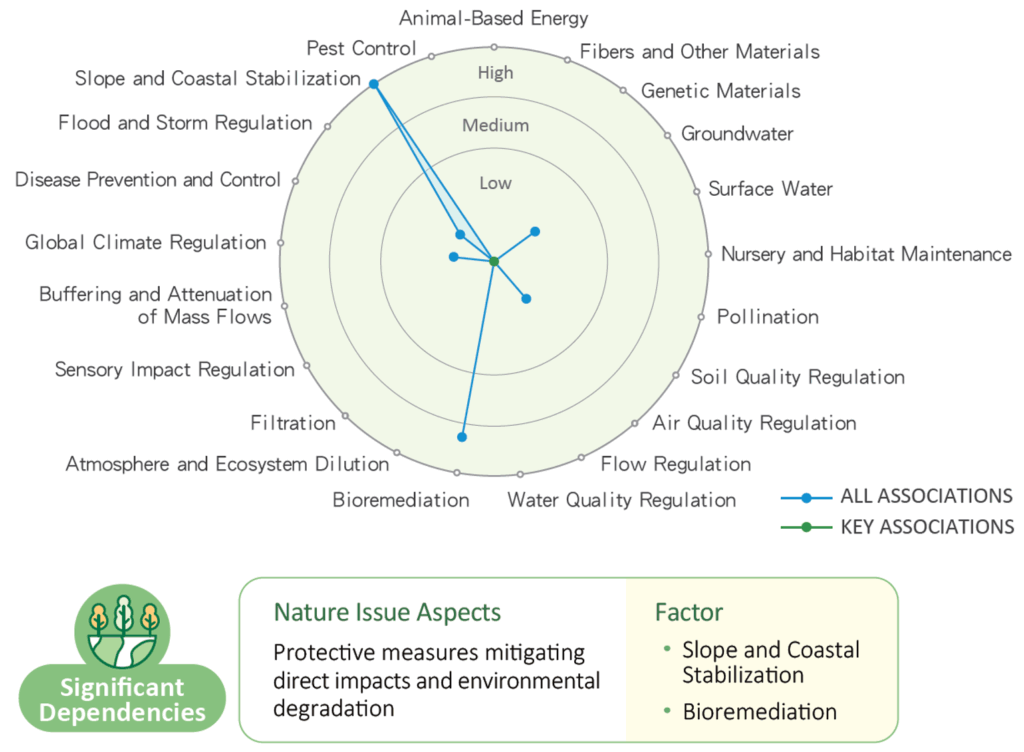
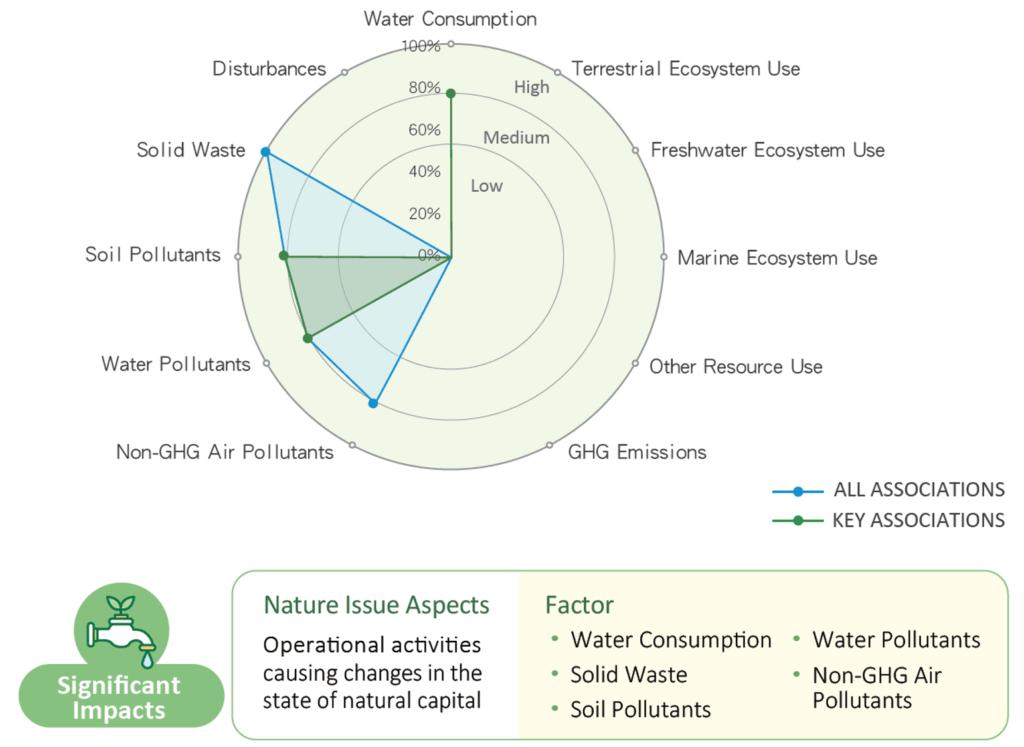
FEDS references the nature-related risk and opportunity database ENCORE (Exploring Natural Capital Opportunities, Risks and Exposure), which classifies the degree of “dependency” and “impact” by industry into five levels—very high, high, medium, low, and very low. Taking into account the weighting of its brand vendors, FEDS analyzes the most significant nature-related issues faced by its brand vendors.
The assessment is conducted from two perspectives: All Associations covers all industries related to the corresponding dependency and impact factors, while Key Associations covers industries highly related to the corresponding dependency and impact factors, thereby providing an understanding of the interrelationship between FEDS’ brand vendors and the natural environment.
- Assess
Transition Risk
Drawing on the above assessment results and supplemented by discussions with relevant internal responsible units, FEDS conducted the following assessments of potential financial impact for three key nature-related risks, which will subsequently be treated as priority aspects for management consideration.
Main Affected Business
- Own Operations
- Suppliers/Brand Vendors
Potential Financial Impacts
Scarcity of natural resources drives up the prices of energy and product raw materials, increasing energy use and product procurement costs, raising operating costs and reducing profits.
Main Affected Business
- Own Operations
- Suppliers/Brand Vendors
Potential Financial Impacts
- Stricter environmental regulations increase restrictions on resource acquisition and waste disposal; department stores may face more stringent energy-saving requirements and waste disposal rules, raising operating costs.
- If suppliers/brand vendors fail to respond promptly to resource acquisition or import-related regulations, supply may be affected, and they may even face legal and reputational risks.
Main Affected Business
- Own Operations
- Suppliers/Brand Vendors
- Customers
Potential Financial Impacts
If brand vendors selling products in the store become involved in negative news about environmental destruction, this may in turn affect FEDS’ own goodwill, leading to customer attrition and a decline in revenue.
Opportunity
FEDS assessed the nature-related opportunity factors across its overall operational activities, summarizing the following 3 opportunities. Leveraging the industry characteristics of the department store sector, FEDS fulfills its responsibility to protect biodiversity while also balancing environmental benefits in the course of its operations.
Main Affected Business
- Own Operations
- Suppliers/Brand Vendors
Opportunity Description
Driven by factors such as changing consumer behavior and government regulations, FEDS collaborates with brand vendors to implement nature-related solutions and develop nature-friendly products and services.
Main Affected Business
- Own Operations
- Suppliers/Brand Vendors
Opportunity Description
Encourage suppliers/brand vendors to adopt certified environmentally friendly packaging materials to respond to market demand for nature-friendly products.
Main Affected Business
- Own Operations
Opportunity Description
Aligning early with the TNFD or other biodiversity-related standards helps reduce future compliance and transition risks.
- Prepare
FEDS systematically takes stock of and consolidates its existing management measures and operating procedures, and, following the four dimensions defined by the TNFD—land, freshwater, ocean, and atmosphere—organizes the environmental practices involved in each operational activity, progressively incorporating nature-related issues into daily operations.
Land
・Roadside Trees and Green Spaces Adoption ・Tree Planting Program ・Waste Reduction Management ・Promoting Green Consumption and Green Office
Atmosphere
・Energy Management ・GHG Emissions Management ・Proper Treatment of Oil Fumes ・Promoting Green Transportation
Ocean
・Mobilizing Employees to Participate in Beach Cleanup ・Organizing Marine Environmental Education Activities
Freshwater
・Promoting Water Conservation Management ・Installing Rainwater Harvesting Systems
Green Building as Urban Green Landmark
FEDS pioneered the trend of department stores by incorporating the green building concept into the design of department store at an early stage. Since 2011, the newly opened stores of FEDS have been planned as new-style environmentally friendly and energy-saving department stores. With the four main focus of “ecology, energy saving, waste reduction, and health”, we have created sustainable and fashionable green department stores, so that the department store is not only a department store, but also a green landmark in the city.
FEDS had five environmentally friendly green buildings in 2025, leading the department store industry in this regard. FEDS Baoqing Store is currently undergoing renovations and will be developed into a high-standard environmentally friendly department store, becoming the company’s sixth green building.
Green Building Concept Members
Top City Taichung Store Mega City Banqiao Store
Headquarters Building
FEDS XinYi A13
FEDS Zhubei