Identification of Material Topics
Analysis of Material Topics
FEDS follows the AA1000 AccountAbility Principles and the GRI Sustainability Reporting Standards, and comprehensively considers domestic and international sustainability development trends, relevant sustainability standards and norms, industry peer practices, and topics of concern to stakeholders, as the core basis for material topic identification and sustainability report disclosure.FEDS conducts a regular annual review of material topics, systematically
evaluating the degree of impact of each topic on the economic, environmental, and people (including human rights) dimensions, and adjusting its sustainability management priorities according to the identification results, as a reference for resource allocation, action planning, and the enhancement of the quality of decision-making by the Board of Directors and management.
Identify Topics
1. Understanding Organizational Context
Following the five aspects of the AA1000 SES stakeholder engagement principles — dependency, responsibility, influence, diversity of perspectives, and level of concern — FEDS identified six major categories of stakeholders: consumers, employees, business partners (counter vendors, suppliers), shareholders/financial institutions, government, and society (media, community).
2. Identification of Actual and Potential Impacts
Referring to domestic and international sustainability regulations and standards, industry environmental changes, company development goals, and stakeholder concerns, 26 sustainability issues were screened out. After discussion by the Corporate Sustainability Committee Executive Office and consideration of related sustainability risks, these were refined to 14 sustainability issues following discussion at the Management Headquarters regular meeting on November 20, 2025, which were then subjected to a questionnaire survey.
3. Assessing Impact Significance
The external stakeholder questionnaire is conducted once every two years; through the previous year’s 842 questionnaires, capturing the impact of sustainability issues on the external economy, environment, and people (including human rights) as perceived by the six stakeholder categories. The internal management questionnaire is conducted once a year; this year, 22 questionnaires were used to assess the degree of impact of sustainability issues on the company’s operations.
Based on the combined results of internal and external stakeholder questionnaire surveys — including the total average score calculated from the degree of positive and negative impact and the level of concern of each stakeholder group — and after reviewing the company’s management policies, implementation measures, and actual sustainability outcomes, 14 material topics were ultimately identified, including 9 key topics (total scores ranging from 4.20 to 4.38), 3 important topics (total scores ranging from 3.90 to 3.98), and 2 basic topics (total scores below 3.68), serving as the priority basis for strategic planning and disclosure.
Compared to the previous year:
this year one material topic name was adjusted, revising “Energy and Resource Management” to “Energy Management,” and, in response to biodiversity and resource circularity trends, a new topic, “Waste Management and Resource Sustainability,” was added, strengthening the clarity and forward-looking nature of the topic framework.
4. Ranking Impact Severity and Disclosure
Sent the “Impact Assessment Questionnaire” to 13 department heads to rate the degree of positive and negative impact of each material topic on “the economy, environment, and people (including human rights).” The impact assessment also considered the impacts of “likelihood of occurrence” and “scale and scope of impact,” and was submitted to the President for approval.
Conducted final confirmation and review of material topics, continuously monitor the positive and negative impacts caused by these material topics, and considered stakeholders’ expectations of FEDS. This will serve as a reference for the appropriateness of material topics in the following year, while ensuring that sustainability information and performance are fully disclosed.
Material Topic Matrix
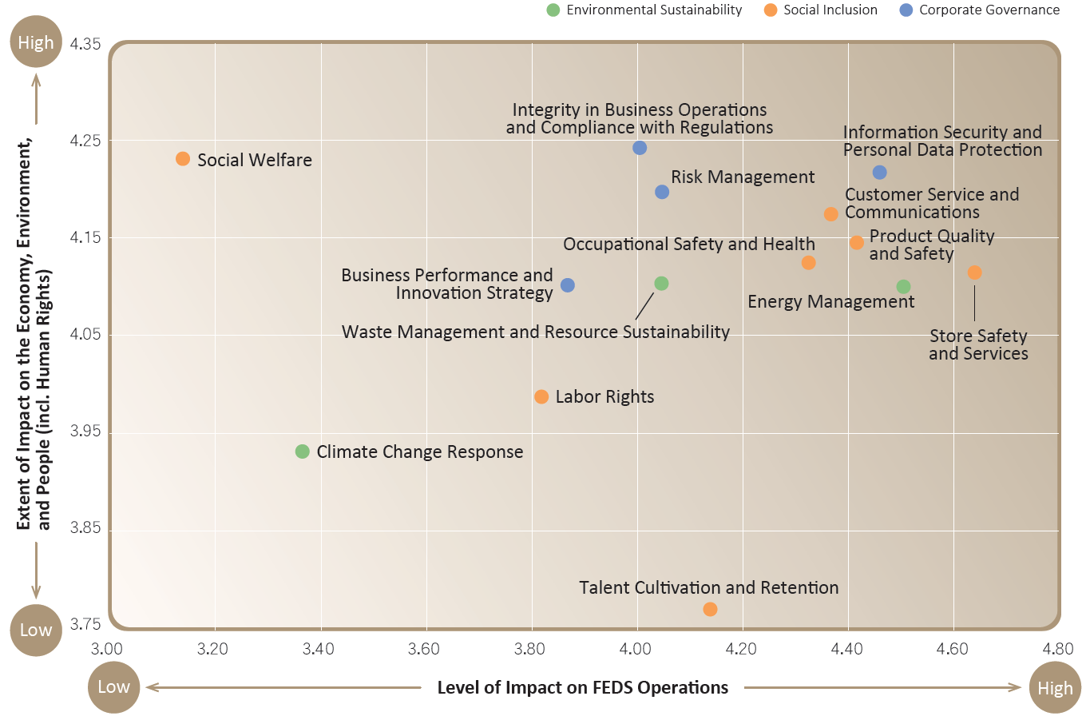
Environmental Sustainability (E)
・Energy Management ・Waste Management and Resource Sustainability ・Climate Change Response
Corporate Governance (G)
・Information Security and Personal Data Protection ・Integrity in Business Operations and Compliance with Regulations ・Risk Management ・Business Performance and Innovation Strategy
Social Inclusion (S)
・Store Safety and Services ・Product Quality and Safety ・Customer Service and Communications ・Occupational Safety and Health ・Talent Cultivation and Retention ・Labor Rights ・Social Welfare
Explanation of Material Topic Adjustments



Adjustment Details
The former “Energy and Resource Management” was split into two topics: “Energy Management” and “Waste Management and Resource Sustainability.”
Reason for Change and Impact
In response to energy transition trends and the rising importance of biodiversity and circular economy, the topic was separated into two material topics to enhance management focus and disclosure transparency.
Adjustment Details
“Business Performance and Innovation Strategy” was adjusted from a key topic to an important topic. “Social Welfare” was adjusted from an important topic to a basic topic.
Reason for Change and Impact
Based on the re-ranking from stakeholder questionnaire and the double materiality assessment, the impact of these topics on the company’s long-term value and external impact has relatively decreased.
Adjustment Details
“Product Quality and Safety” and “Risk Management” were elevated to key topics. “Talent Development and Retention” and “Labor Rights” were elevated from basic topics to important topics.
Reason for Change and Impact
As retail operational risks, supply chain responsibility, and the competition for talent intensify, the impact of these topics on operational resilience and brand trust has increased, so their materiality levels were adjusted.
Impact Assessment
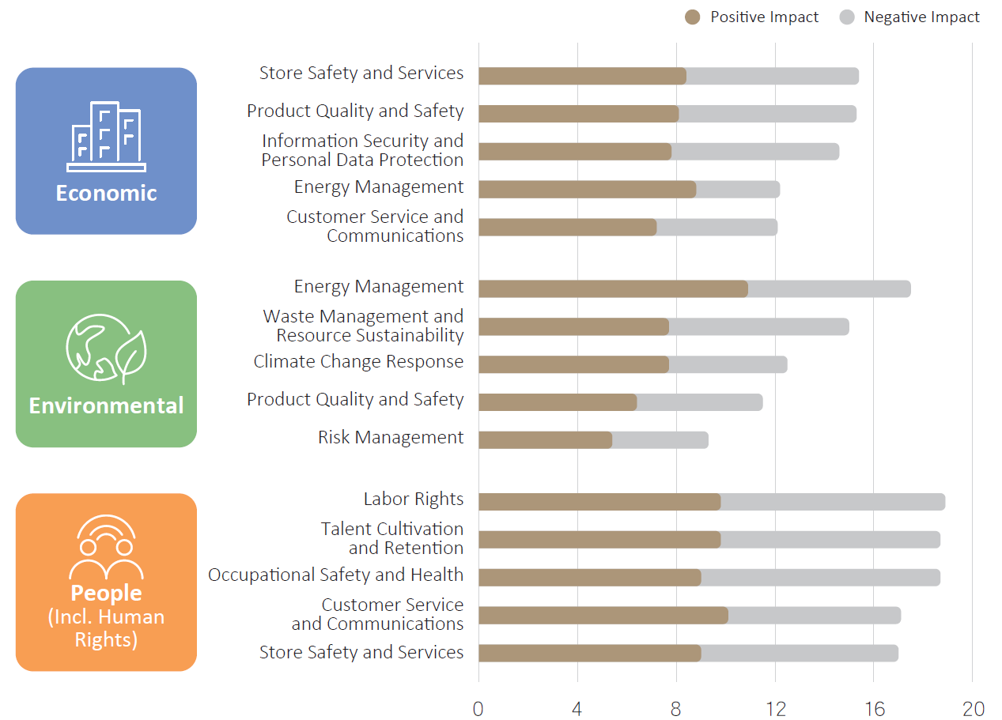
FEDS follows the materiality identification process set out in the GRI Standards and adopts the Double Materiality principle proposed by the European Union, identifying 14 material topics. Through a quantitative scoring mechanism, it comprehensively considers the severity, likelihood of occurrence, and scope of impact, completing an overall ranking of the degree of impact, and further identifying the top five topics in terms of degree of impact across the three dimensions of economy, environment, and people (including human rights), as a basis for resource allocation and management priorities.
Among them, “Product Quality and Safety” presented the highest potential for positive impact in the assessment, indicating that FEDS’ efforts in product quality management, supplier control, and food safety mechanisms have already taken effect, with key influence on safeguarding consumer rights and enhancing service trust. In the future, FEDS will continue to strengthen quality monitoring, risk prevention, and supply chain management through institutionalized management and continuous improvement mechanisms, in accordance with regulatory requirements and market trends.
“Occupational Safety and Health” showed relatively high negative impact in the assessment results, mainly reflecting that there is still room for improvement in safety management and regulatory compliance at operating locations. For the relevant deficiencies that occurred during the year, FEDS has completed improvements and incorporated them into a tracking and management mechanism. In the future, FEDS will continue to reduce potential risks and enhance the maturity of workplace safety management through institutional optimization and internal audit mechanisms.
Impact Assessment Results of Material Topics
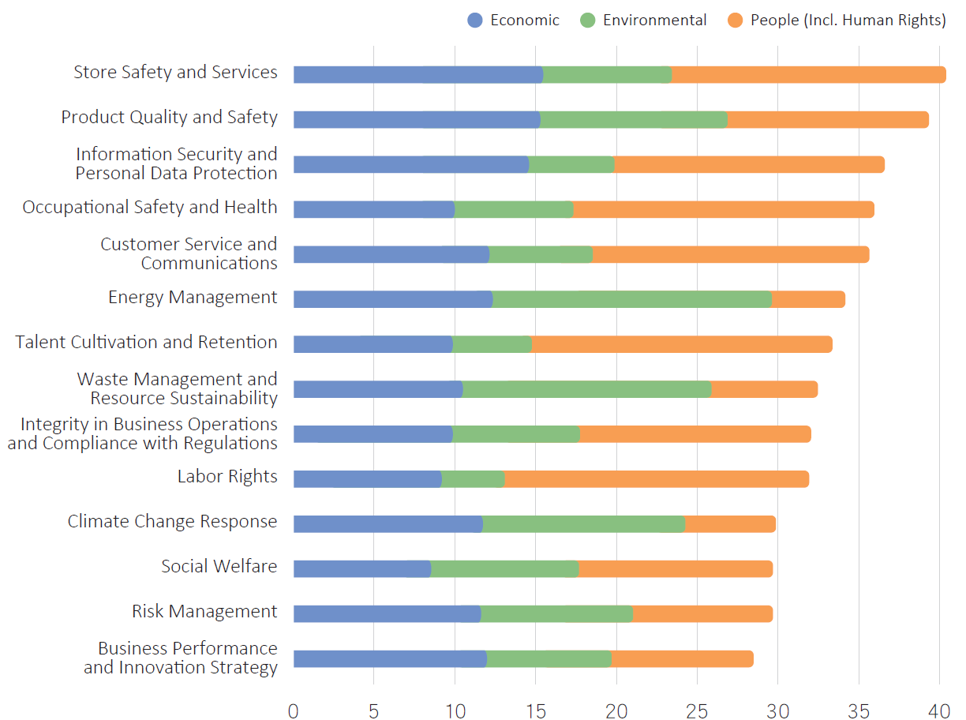
Top 5 in Terms of Economic,
Environmental and Human Rights Impacts
Impact Description and Management
| Regularly review store safety and facilities, and carry out internal staff communication training to ensure mall safety and service quality, thereby protecting the company’s reputation. | Customers, Employees, Community | FEDS provides safe shopping and response mechanisms, reducing accident risks and strengthening trust. | ||||
| Customers, Employees | Inadequate safety management may lead to accidents, operational interruptions, and reputational losses. | |||||
| Establish information security systems and management mechanisms, conduct regular audits and drills to ensure information security and personal data protection. | Customers, Employees | FEDS strengthens information security and privacy protection by establishing an information security system and management mechanism. | ||||
| Customers, Employees | Information security incidents may lead to privacy infringement, operational interruptions, and expose the company to regulatory risks. | |||||
| Advance energy-saving equipment optimization, energy monitoring mechanisms to respond to net-zero trends and regulatory requirements. | Environment, Investors | Energy-saving measures reduce carbon emissions and operating costs, enhancing climate governance performance. | ||||
| Environment, Investors | High-energy-consumption operations may increase greenhouse gas emissions, environmental burden, and operating costs. | |||||
| Product labeling and quality inspection comply with relevant health and safety regulations, providing high-quality products to ensure customer health and safety. | Customers, Suppliers | Rigorously controlling product quality and food safety ensures customer health and enhances brand trust. | ||||
| Customers | Product defects or food safety incidents may cause health risks and liability for compensation. | |||||
| Through comprehensive training programs to enhance service quality, FEDS has established multiple channels to maintain communication with customers. | Customers | Establishing good service processes and communication channels maintains long-term customer trust and enhances satisfaction. | ||||
| Customers | Inadequate service quality or failure to handle complaints promptly and properly causes a decline in satisfaction. | |||||
| Enhance workplace safety and hygiene to promote employees’ physical and mental health, ensuring they can work with peace of mind. | Employees, Contractors | Good occupational safety management can reduce the incidence of accidents and enhance employee wellbeing. | ||||
| Employees, Contractors | Violations or inadequate management may lead to occupational safety accidents, fines, and health risks. | |||||
| Establishing a culture of integrity and honesty, and implementing compliance management, are fundamental to sustainable operations. | Investors, Employees, Suppliers | Establishing governance and internal control mechanisms can reduce corruption risk and enhance corporate transparency and market trust. | ||||
| Investors | Violations or dishonest conduct may result in penalties and reputational losses. | |||||
| Advance waste reduction and resource circular reuse, reducing the impact of operational activities on the environment. | Environment, Community | Advancing waste reduction and circular recycling measures implements resource sustainability. | ||||
| Environment, Community | Improper waste handling may cause environmental pollution and regulatory risks. | |||||
| A sound risk management system is essential to ensure the smooth operation of all business activities and to reduce impacts on the economy, environment, and society. | Investors, Employees, Customers | Comprehensive risk identification and control can reduce operational impacts and enhance corporate resilience. | ||||
| Investors, Employees, Customers | Inadequate risk identification may lead to operational interruptions or financial losses. | |||||
| Innovating and transforming in step with the times to drive operational performance and enhance profitability are key factors for the continued development of FEDS. | Investors, Employees | Innovation and the enhancement of operational performance can promote industry upgrading and corporate competitiveness. | ||||
| Investors, Employees | Inadequate innovation and operational performance may weaken corporate growth momentum. | |||||
| Cultivate employees’ professional skills and offer competitive compensation to attract and retain talent, ensuring the stable development of the company. | Employees, Customers | A comprehensive talent development and growth system can enhance service quality and organizational stability. | ||||
| Employees | Inadequate professional training will make it impossible to attract and retain outstanding talent, affecting the company’s long-term development. | |||||
| Formulate and implement human rights management policy to protect the rights and interests of employees. | Employees, Counter and Outsourced Personnel | Complying with human rights policies and regulations can reduce labor risks and strengthen employee cohesion. | ||||
| Employees, Counter and Outsourced Personnel | Failure to uphold labor rights may give rise to issues such as discrimination, overtime, or forced labor. | |||||
| Integrating resources to transform each business location into a local public welfare platform, thereby creating the greatest overall social impact. | Community, Society | Investing corporate resources in public welfare can strengthen social influence and local connections. | ||||
| Community, Society | A lack of planning or improper resource allocation may reduce influence. | |||||
| Identify climate change risks and opportunities, enhance climate response resilience and transformation adaptability, moving toward the 2050 net-zero goal. | Environment, Investors | Carbon reduction strategies and transformation actions can reduce climate risks and operational impacts. | ||||
| Environment, Investors | Failure to effectively manage carbon emissions may result in policy and market risks. |
Identify Topics
I. Understanding Organizational Context
According to the AA1000 SES stakeholder engagement principles—dependence, responsibility, influence, diversity of perspectives, and level of concern—FEDS has identified six major categories of stakeholders: consumers, employees, business partners (counter vendors and suppliers), shareholders/financial institutions, government, and society (media and community).
II. Identification of actual and potential impacts
Referring to domestic and international sustainability regulations and standards, industry environmental changes, company development goals, and stakeholder concerns, 38 sustainability issues were identified. After discussion by the Corporate Sustainability Committee Executive Office and consideration of related sustainability risks, these were refined to 13 sustainability issues, which were then subjected to a questionnaire survey.

III. Assessment of impact severity
Through a questionnaire survey, FEDS assessed the impact of sustainability issues on the external economy, environment, and people (including human rights) as perceived by six major stakeholder groups. Although 765 questionnaires were originally planned for distribution, a total of 842 were actually collected, comprising consumers (337), employees (295), business partners (127), shareholders/financial institutions (23), government (17), and society (43). Additionally, 19 internal management questionnaires were conducted to evaluate the extent of sustainability issues’ impact on the company’s operations.
Based on a comprehensive analysis of internal and external survey results, as well as a review of management policies, implementation measures, and sustainability outcomes, 13 material topics were ultimately identified, including 7 key topics, 3 important topics, and 3 basic topics.
Compared to the previous year:
“Social Welfare” was added; “Energy Management” and “Water and Waste Management” were consolidated into “Energy and Resource Management”; “Integrity Management” and “Regulatory Compliance” were consolidated into “Integrity Management and Regulatory Compliance.”
Regarding material changes:
“Integrity Management and Regulatory Compliance,” ” Occupational Safety and Health ,” and “Business Performance and Innovation Strategy” have been elevated from important topics to key topics. “Talent Development and Retention” has been downgraded from an important topic to a basic topic. The materiality of the remaining nine topics remains unchanged.
IV. Ranking impact severity and disclosure
Sent the “Impact Assessment Questionnaire” to 12 department heads to rate the positive and negative impact levels of major topics on external economy, environment, and people (including human rights). The impact assessment considered both the likelihood of occurrence and the scale and scope of impact, and was submitted for the approval of the President.
Conducted final confirmation and review of material topics, continuously monitoring the positive and negative impacts caused by these material topics, and considering stakeholders’ expectations. This will serve as a reference for the appropriateness of material topics for the following year, while ensuring that sustainability information and performance are fully disclosed.
經濟、環境、人權衝擊排序前5名
經濟